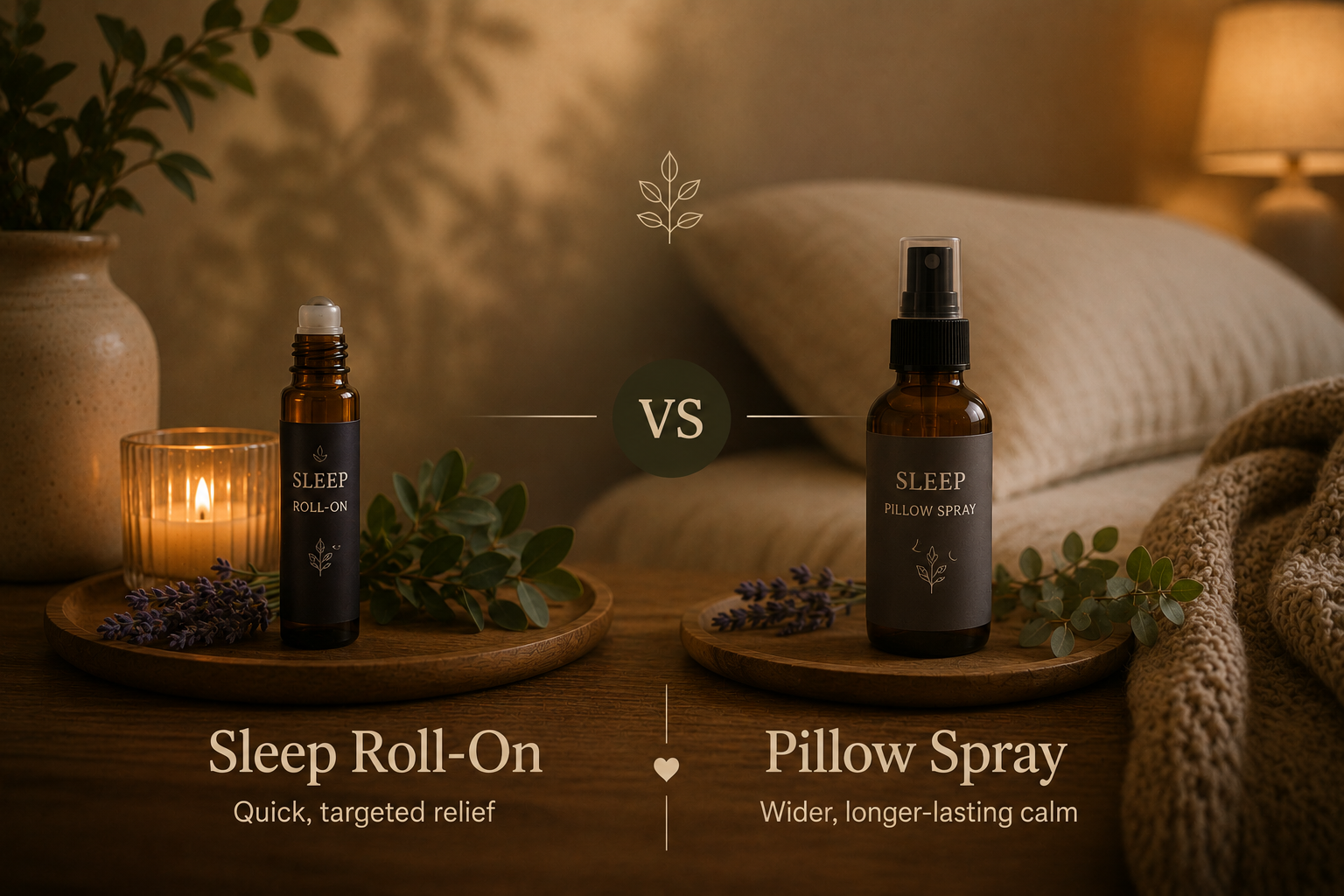
I used to dread bedtime. Not because I wasn’t tired, but because I knew what was coming: lying awake for an hour, mind refusing to switch off, watching the clock tick past midnight. I tried everything from magnesium supplements to sleep meditations before a friend suggested aromatherapy. I was skeptical. Then I bought both a sleep roll-on and a pillow spray the same week, and what I discovered surprised me.
They are not interchangeable. One works better for a specific type of insomnia than the other. Here is exactly what I found.
Sleep Roll-On vs Pillow Spray: Which Is Better for Insomnia?
Before picking a side, you need to understand one thing: these two products solve different sleep problems. Using the wrong one for your specific issue is why most people dismiss aromatherapy as ineffective. You may also want to read essential oils for sleep.
How a Sleep Roll-On Works?
A sleep roll-on applies a pre-diluted essential oil blend directly to your pulse points, wrists, temples, and neck. The rollerball oil bottle deposits aromatic compounds onto skin, where inhalation begins immediately and stays concentrated close to your nose as you settle into bed. You may also want to read how to dilute essential oils.
The science behind this is straightforward. Volatile compounds from insomnia essential oils like linalool and linalyl acetate from lavender travel through the nasal mucosa, activate olfactory receptors, and signal the limbic system within seconds. This triggers GABA and serotonin release, lowers cortisol, and slows heart rate. Your body receives a clear biological signal: it is time to wind down. Related reading: taking essential oils on a plane.
What I noticed personally was that the intentional pulse point application itself became part of my pre-sleep ritual. Rolling it on my wrists, pressing them to my temples, taking three slow breaths. That 60-second act alone started training my brain to associate the scent with sleep. Within two weeks, the smell of cedarwood oil and vetiver oil made my eyes heavy before I even hit the pillow.
How a Pillow Spray Works?
A pillow spray, or pillow mist, works completely differently. You spritz it across your pillowcase and bedding before lying down. Aromatic molecules disperse passively into the air around your face throughout the night. No skin contact, no intentional ritual, no concentrated peak effect. If this topic interests you, see applying essential oils directly to skin.
The first time I used a lavender sleep spray, I noticed the scent immediately when I lay down. It was softer and more diffuse than the roll-on, more like walking into a calm room than applying something directly. The ambient quality is exactly the point. A linen spray creates an environmental sleep enhancement layer rather than a targeted therapeutic hit.
Where the Roll-On Wins: Falling Asleep
If your insomnia is about falling asleep, the sleep roll-on is the better product. Full stop.
Lavender oil reaches peak concentration in the bloodstream around 18 minutes after inhalation, with a half-life of approximately 104 minutes. That window maps directly to the period when sleep onset insomnia sufferers struggle most. A bedtime roll-on applied at pulse points maximises aromatic concentration exactly during those critical minutes.
A 2025 meta-analysis in Frontiers in Psychiatry confirmed significant improvements in sleep quality measures from inhalation aromatherapy, and the strongest results came from concentrated inhalation at sleep onset, not passive overnight diffusion. The roll-on delivers that concentration. A pillow mist simply cannot match the intensity of a roller held two inches from your nose.
I stopped taking 45 minutes to fall asleep within ten days of using a deep sleep blend roll-on consistently. That result came from the combination of the olfactory-limbic system pathway activation and the conditioned pre-sleep cue the ritual created.
Where the Pillow Spray Wins: Staying Asleep
Here the pillow spray takes over, and this is where most comparisons get it wrong.
If you fall asleep fine but wake at 2 or 3 AM and cannot get back down, a roll-on is not your answer. Waking up to reapply it only disrupts your sleep further. A bedtime spritz already saturating your pillowcase continues delivering mild olfactory stimulation throughout the night without any intervention from you.
This passive, sustained scent delivery supports deeper sleep architecture across the full sleep cycle. Bergamot relaxation oil and chamomile oil for sleep work particularly well in pillow sprays because their calming compounds, including apigenin from chamomile, sustain a gentle relaxation-induced state rather than spiking and fading. A 2024 review in Complementary Therapies in Medicine covering over 700 participants found chamomile inhalation reduced night-time awakenings significantly over 15 days.
I used a vetiver and chamomile pillow mist during a period of particularly fragmented sleep and noticed fewer wake-ups within a week. The scent was subtle enough not to be intrusive but consistent enough to keep the nervous system calm.
For Travel: Roll-On Every Time
A 10ml rollerball oil bottle fits in any pocket or bag. A pillow spray comes in a 100ml bottle that risks staining hotel pillowcases and gets flagged at airport security. When I travel, the roll-on maintains my bedtime routine across time zones without any hassle. For managing jet lag and unfamiliar sleep environments, the portable essential oil roller is the only practical option.
For Sensitive Skin: Stick With Pillow Spray
Topical essential oils require a patch test. Citrus-forward blends containing bergamot can cause photosensitivity on reactive skin. If you have eczema, rosacea, or sensitive skin in general, a pillow spray eliminates all contact risk while still delivering the same sleep aromatherapy benefits through inhalation.
Can You Use Both Together?
Yes, and this is what I do now.
I apply the roll-on 15 to 20 minutes before sleep to address sleep onset, then spritz the pillow mist at the same time to cover the rest of the night. The roll-on handles the hardest part, falling asleep, while the linen spray sustains the sleep environment. This combination works for mixed insomnia where both falling and staying asleep are problems.
Conclusion
Here is the definitive answer: a sleep roll-on works better for falling asleep, and a pillow spray works better for staying asleep. The ingredients overlap. The delivery mechanism does not, and that difference determines everything.
Match the product to your problem. If you stare at the ceiling for an hour every night, start with a roll-on. If you wake at 3 AM and lie there until 5, reach for a pillow mist. If both happen regularly, use them together.
After testing more blends than I can count, the formulas I keep coming back to are from Lume & Wick.