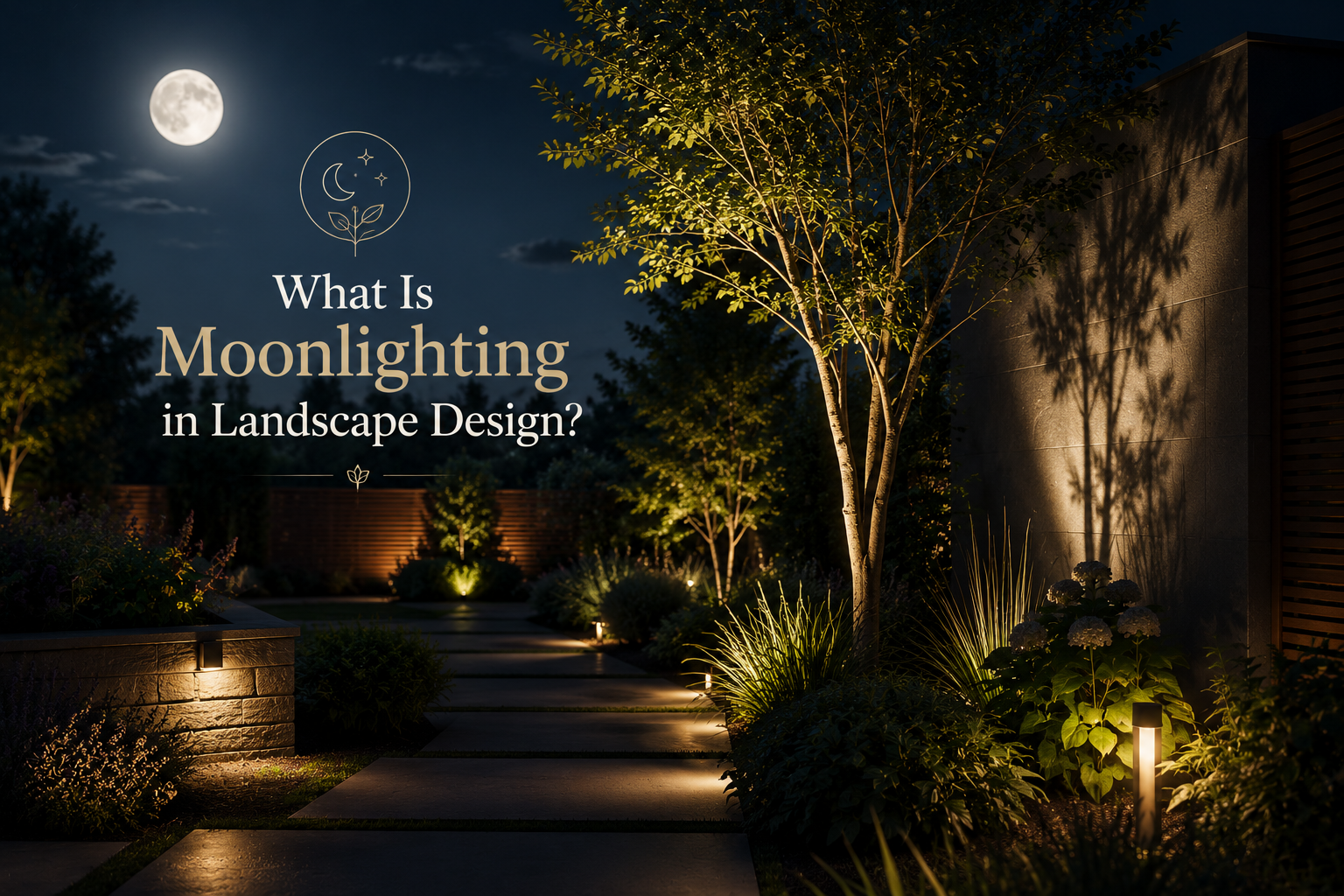
The first time I saw moonlighting done right, I almost missed it. I was standing in a friend’s backyard at dusk, and the light on the patio looked like it was coming from nowhere. Soft patches drifted across the stone, shifting slightly with the breeze. That’s the magic of moonlighting in landscape design: a technique where fixtures sit high in tree branches and cast light downward, mimicking the way real moonlight filters through leaves.
Unlike most outdoor lighting methods that announce themselves, moonlighting hides its source. You notice the effect long before you spot the fixture. It creates a naturalistic outdoor lighting style that feels less like installed hardware and more like a quiet gift from the night sky. Homeowners drawn to subtle night garden aesthetics, rather than bold spotlights or glowing pathways, tend to fall for this technique fast.
How Moonlighting Lighting Works
Moonlighting relies on a simple setup with a surprisingly complex payoff. Installers mount small, weatherproof fixtures thirty feet or higher into mature tree canopies, angling each one downward. The light then filters through branches and leaves before reaching the ground, breaking into soft, irregular patterns instead of one solid beam. Bulb color matters too: compare warm white vs daylight bulbs for a natural, moon-like tone.
Two factors control the final look: beam spread and light diffusion. A wider beam spread covers more ground but softens intensity, while a narrower one creates sharper, more defined shadow shapes. Diffusion happens naturally as light passes through foliage, scattering it into that signature dappled glow.
I’ve found that even small adjustments, like shifting a fixture six inches to the left, can completely change how shadows fall across a patio or lawn. This tree-mounted lighting approach depends heavily on branch density, so no two installations ever look quite the same.
Moonlighting vs. Uplighting
People often confuse these two techniques, but they work in opposite directions. Uplighting places fixtures at ground level and points them upward, usually to highlight a tree trunk, facade, or architectural feature with dramatic emphasis.
Moonlighting does the reverse. Fixtures sit above and cast downward light casting that mimics moonlight rather than showcasing a structure. If uplighting is meant to be seen, moonlighting is meant to be felt.
I need semantic and NLP terms for the topic “What Is Moonlighting in Landscape Design” and make sure they are highly relevant to the topics. Here’s the list of terms I want:
- Semantic terms
- Lexical terms
- Unique attributes
- Rate attributes
- Common attributes
Where Moonlighting Works Best
Moonlighting isn’t a fit for every yard, and that’s worth saying upfront. This technique needs mature trees with a full, wide canopy to filter light properly. Young saplings or sparse branches simply don’t offer enough coverage to create that dappled, layered effect. Along stairs and paths, LED step lights add a safe low-level glow that complements the effect. To plan fixture count and spacing, try our landscape lighting calculator.
The best candidates are outdoor spaces built for evening use: patios tucked beneath oak or maple canopies, seating areas near a fire pit, or garden pathways that wind under tree cover. In these spots, moonlighting adds ambient garden illumination without competing with conversation or overpowering the setting. I’ve seen it work beautifully over dining areas too, where guests get soft, flickering light instead of harsh overhead glare. On traditional facades, pair it with the best outdoor lighting for a colonial-style home.
If your property has open lawns with little canopy lighting potential, other techniques like path lighting or uplighting will likely serve you better. Moonlighting rewards patience and the right landscape, not every backyard.
Benefits of Moonlighting in Landscape Design
The appeal of moonlighting goes beyond aesthetics, though that’s usually what draws people in first. Here’s what makes it worth considering: Most designers stay within 2700K vs 3000K lighting for a natural night look.
- Nighttime curb appeal: Soft, layered light gives your property a polished, high-end look after sunset without feeling staged.
- Improved safety: Diffused light across walkways and patios helps guests navigate without the glare of direct fixtures.
- Depth and dimension: Shadows shift naturally as branches move, adding visual texture that flat lighting can’t replicate.
- Energy efficiency: Most moonlighting setups use low-voltage LED fixtures, keeping consumption modest even when several lights run through the evening.
What surprised me most when I first tried this was how calm the space felt. There’s no glare, no single bright point pulling your eye. Just light that behaves the way moonlight actually does, quiet and unpredictable. For indoor spaces, read how to choose lighting for your home.
Installation Considerations
Before installing moonlighting, a few practical details matter more than people expect. Fixture height plays a big role. Mounting too low reduces the spread of light and weakens the effect, while proper placement high in the canopy lets branches do the diffusing work naturally.
Trees grow, and that changes everything over time. Branches thicken, shift, and sometimes block light paths that worked perfectly the year before. Plan on periodic adjustments every season or two to keep the effect consistent. Weatherproofing also deserves attention since fixtures sit exposed to rain, wind, and temperature swings year round.
Climbing into mature trees to wire and mount fixtures isn’t a beginner task. I’d always recommend professional installation here, both for safety and for getting the angles right the first time. A skilled installer knows how to balance beam spread with branch structure, something that’s hard to get right through trial and error alone.
Is Moonlighting Right for Your Yard?
Ask yourself three quick questions. Do you have mature trees with a full canopy? Is there a patio, deck, or seating area beneath that canopy? And do you prefer subtle, natural light over dramatic spotlighting?
If you answered yes to most of these, moonlighting is likely a strong fit. It won’t work everywhere, but where the conditions align, few techniques create such a peaceful, natural nighttime atmosphere.
Conclusion
Moonlighting in landscape design recreates something we all recognize instinctively: the soft, uneven glow of real moonlight breaking through leaves. It takes the right trees, careful planning, and a bit of patience, but the payoff is a backyard that feels calm and alive after dark.
I’ve tested plenty of outdoor lighting styles over the years, and moonlighting remains one of the few that genuinely surprises people the first time they see it in person. If you’re ready to bring that same quiet glow to your own evenings outdoors, Lume & Wick offers home lighting pieces designed to complement exactly this kind of ambiance, indoors and out.