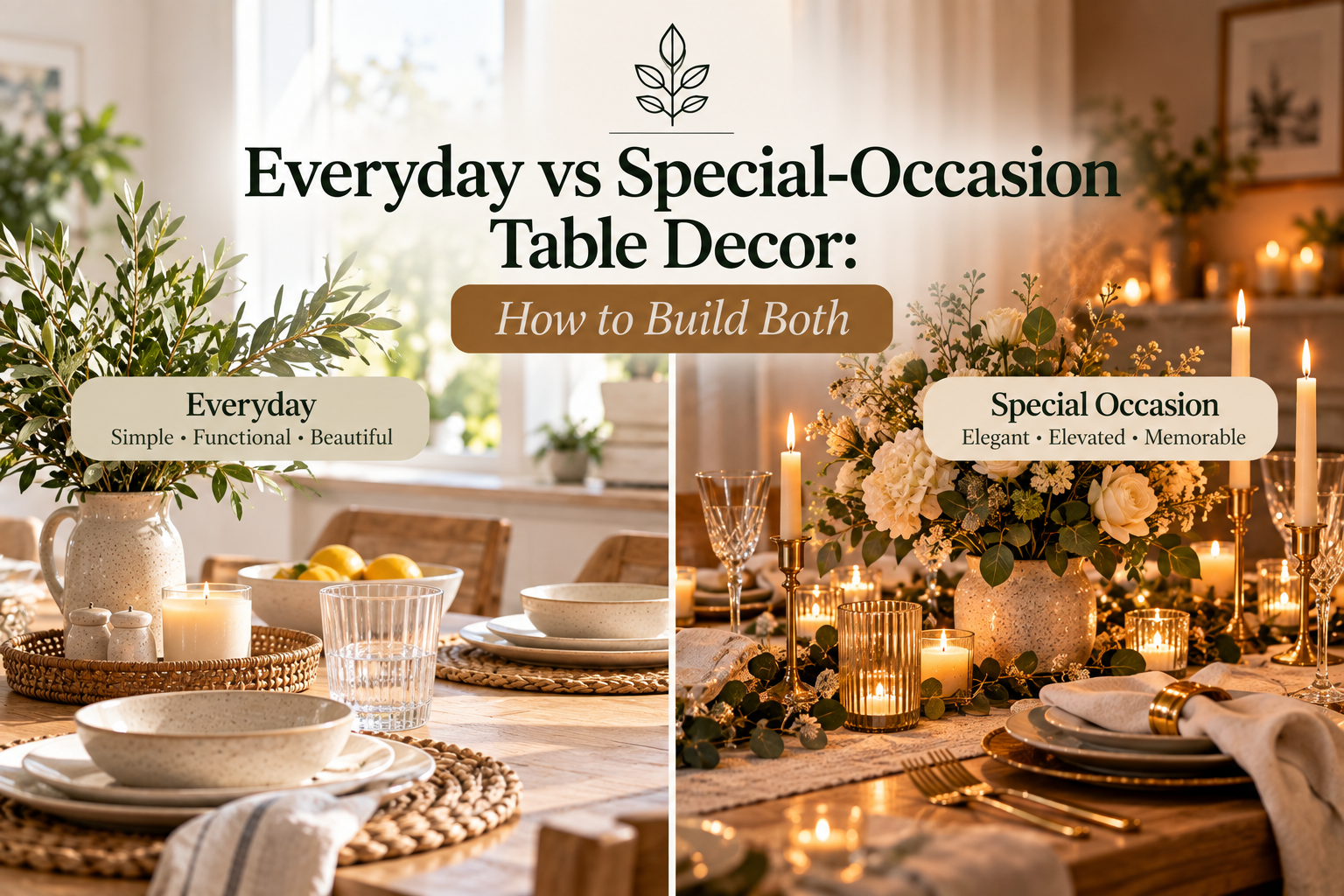
A beautifully decorated table does not have to be reserved for holidays, dinner parties, or special celebrations. At the same time, your everyday table should not have to look like a formal dining room display every day.
The easiest approach is to build two layers of table decor: a practical everyday foundation and a more decorative special-occasion layer. This lets you change the mood of your dining area without buying an entirely new collection of tableware and accessories.
The key is knowing which pieces deserve to stay and which ones should come out when you are entertaining.
Start With an Everyday Table Foundation
Everyday table decor should be attractive enough to make the room feel finished but practical enough that you can eat, work, clean, and move around without constantly rearranging everything.
Start with a few foundational elements:
- A simple table runner or placemats
- Everyday dinnerware
- A small centerpiece
- A practical vase or bowl
- Simple napkins
- One or two decorative accents
The goal is restraint. Too many objects can make a dining table feel crowded and make everyday meals unnecessarily complicated.
For a rectangular dining table, a runner can provide visual structure without covering the entire surface. On a round table, a small centerpiece or circular tray can create the same effect.
Choose a Neutral Everyday Palette
Neutral colors are particularly useful for everyday decorating because they work with different seasons and occasions.
Consider combinations such as:
- Cream and natural wood
- White and beige
- Soft gray and black
- Warm taupe and brown
- Off-white and muted green
This does not mean your everyday table needs to be boring. Texture can provide much of the visual interest.
A linen runner, ceramic bowl, wooden tray, woven placemats, or textured napkins can make a neutral table feel layered without adding strong colors.
Keep the Centerpiece Low
A common mistake with dining tables is choosing a centerpiece that is too tall.
A large arrangement may look impressive in photographs, but it can interfere with conversation when people are sitting across from each other.
For everyday use, choose something relatively low, such as:
- A shallow ceramic bowl
- A small vase
- A wooden tray
- A cluster of small candles
- A low arrangement of branches
- A decorative fruit bowl
The centerpiece should define the table without becoming the main obstacle on it.
Build Around One Decorative Anchor
Instead of decorating every part of the table, choose one anchor piece.
This could be a large ceramic bowl, a sculptural vase, a wooden tray, or a centerpiece made from natural materials.
Then add smaller pieces around it.
For example, a simple everyday arrangement might include a wooden tray in the center, a ceramic vase inside it, and a small candle beside the vase.
This creates a finished look while leaving enough usable space for everyday meals.
Make Special-Occasion Decor More Layered
Special occasions give you more freedom to decorate.
When hosting Thanksgiving, Christmas, a birthday dinner, an anniversary meal, or a dinner party, you can introduce additional layers that would feel unnecessary on an ordinary weekday.
Start with your everyday foundation and build on top of it.
You might add:
- Cloth napkins
- Decorative napkin rings
- Chargers
- Seasonal tableware
- Candlesticks
- Larger floral arrangements
- Decorative glassware
- Place cards
- Seasonal branches
- Decorative table runners
The advantage of this approach is that you do not need two completely separate collections.
Your everyday pieces become the foundation for your formal table.
Use Lighting to Change the Mood
Lighting can transform table decor more dramatically than another decorative object.
For everyday meals, overhead lighting or a nearby pendant can provide practical illumination.
For special occasions, introduce warmer layers through candles, lanterns, or smaller accent lights.
Candles are particularly effective because they add both light and atmosphere without requiring a major change to the table itself.
If you have children or pets, consider flameless candles as a practical alternative.
Mix Heights Carefully
Special-occasion tables can benefit from variation in height.
A table might combine:
- Low plates
- Medium-height floral arrangements
- Tall candlesticks
- Small decorative objects
However, height should still be controlled.
If every object is tall, the table can feel visually heavy. If everything is at the same height, the arrangement may appear flat.
A mixture of low, medium, and occasional tall elements creates a more dynamic composition.
Bring in Seasonal Color
Special occasions are a good opportunity to move beyond your everyday neutral palette.
For autumn, consider rust, olive, brown, cream, and muted orange.
For winter celebrations, deep green, burgundy, cream, metallic accents, and natural wood can create a warmer atmosphere.
Spring tables can introduce soft greens, pale blues, or delicate florals.
Summer dining works well with lighter linens, natural textures, fresh greenery, and brighter accents.
You do not need to replace everything. Changing napkins, flowers, candles, or a runner can be enough to make the table feel seasonal.
Invest in Reusable Pieces
If you entertain regularly, prioritize decorative pieces that can work across multiple occasions.
A set of neutral linen napkins can work for a birthday dinner, Thanksgiving, Christmas, or an ordinary Sunday meal.
Similarly, clear glass candle holders, white ceramic serving pieces, wooden trays, and simple vases can adapt to almost any table setting.
This is usually more practical than purchasing highly specific decorations for every holiday.
Create a Formal Table Without Making It Feel Stiff
A special-occasion table does not have to look like a restaurant or wedding reception.
You can combine formal elements with relaxed materials.
For example, pair elegant glassware with linen napkins and a rustic wooden centerpiece. Or use classic white dinnerware with natural branches and handmade ceramic pieces.
The contrast between refined and natural materials can make the table feel more personal.
Everyday vs Special-Occasion Table: A Simple Comparison
| Element | Everyday Table | Special Occasion |
|---|---|---|
| Runner | Simple and durable | Decorative or seasonal |
| Centerpiece | Small and low | Larger or layered |
| Napkins | Practical fabric or paper | Cloth with decorative details |
| Candles | Optional | Often useful |
| Dinnerware | Everyday set | Special or upgraded set |
| Glassware | Basic | Coordinated or decorative |
| Color | Neutral | Seasonal or event-specific |
| Accessories | Minimal | Layered |
| Flowers | Small arrangement | Larger arrangement |
| Place settings | Simple | More structured |
Store Your Special-Occasion Pieces Together
One of the easiest ways to make seasonal decorating manageable is to keep your special table accessories organized in one location.
Use labeled storage boxes for:
- Holiday napkins
- Table runners
- Candlesticks
- Napkin rings
- Seasonal ornaments
- Place cards
- Decorative chargers
Keep everyday pieces somewhere easily accessible.
When a special occasion arrives, you can simply bring out one box and change the table rather than searching through multiple storage areas.
The Best Tables Use the Same Design Language
The most successful everyday and special-occasion tables usually share a common visual language.
If your everyday table uses natural wood, cream ceramics, and woven textures, your formal table can introduce darker colors, glass, candles, and seasonal greenery while maintaining those same natural elements.
This creates continuity throughout the home.
You are not creating two completely different decorating styles. You are simply changing the level of detail.
Final Thoughts
The easiest way to decorate a dining table throughout the year is to build a flexible foundation rather than constantly starting from scratch.
Keep your everyday table simple, practical, and comfortable. Then create a collection of reusable decorative pieces that can be layered on top when guests arrive or a special occasion comes around.
A low centerpiece, neutral linens, versatile dinnerware, and natural textures can form the everyday foundation. Seasonal runners, candles, flowers, decorative glassware, and special napkins can transform that foundation when you want something more memorable.
The result is a table that feels considered every day but still has plenty of room to become special when the occasion calls for it.