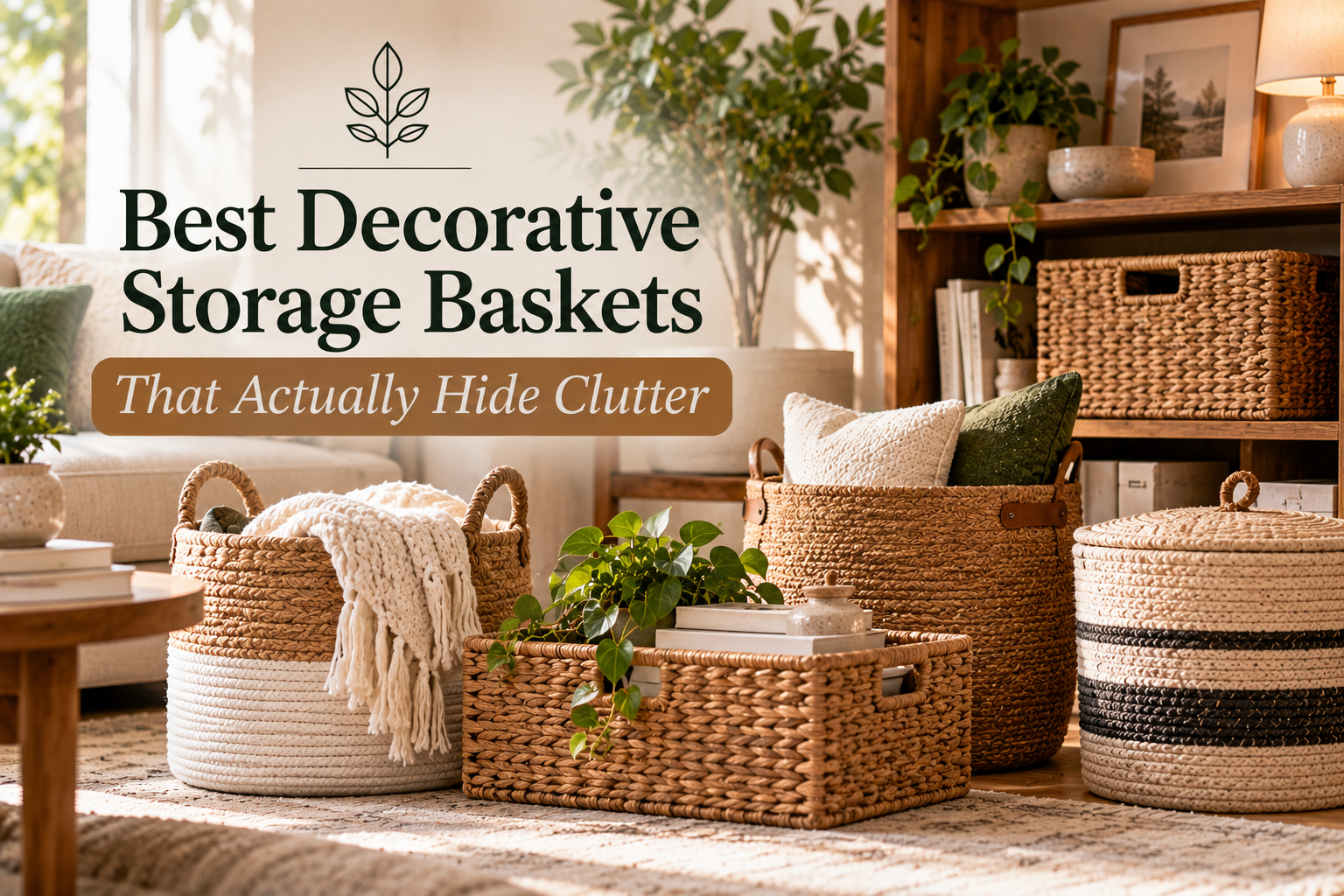
Storage baskets are one of the easiest ways to make a home feel more organized without turning every room into a collection of plastic bins and storage containers.
The challenge is finding baskets that are actually useful. A basket can look beautiful in a product photo but still fail in everyday life if it is too shallow, difficult to carry, impossible to clean, or too open to properly hide the things you want out of sight.
The best decorative storage baskets combine practical capacity with materials and shapes that complement the room. From woven baskets for blankets to lidded baskets for toys and smaller storage bins for entryways, the right design can make everyday clutter much easier to manage.
What Makes a Good Decorative Storage Basket?
Before choosing a basket based on appearance, think about what you actually need to store.
A good decorative basket should ideally be:
- Large enough for the items it needs to hold
- Easy to access
- Sturdy enough for regular use
- Easy to move when necessary
- Appropriate for the room
- Able to conceal clutter
- Simple to clean or maintain
The most attractive basket is not necessarily the most useful one.
For example, an open woven basket may work beautifully for folded blankets because you can see what is inside. The same basket may be a poor choice for children's toys, cables, paperwork, or miscellaneous household items that you want completely hidden.
1. Large Woven Baskets for Blankets
A large woven basket is one of the most useful decorative storage pieces for a living room.
Blankets are bulky, difficult to fold perfectly, and often end up draped over sofas and chairs. A large basket placed beside the sofa gives them a dedicated home.
Look for baskets made from materials such as:
- Seagrass
- Rattan
- Water hyacinth
- Wicker
- Natural fibers
A tall basket can hold several throws while taking up relatively little floor space.
Choose one with sturdy handles if you expect to move it frequently.
Best for: Blankets, throws, cushions, and extra pillows.
2. Lidded Baskets for Hidden Storage
If your main goal is to hide clutter, a lid makes a significant difference.
Lidded baskets are particularly useful for objects that do not contribute to the appearance of a room but need to remain accessible.
They can hide:
- Toys
- Pet accessories
- Electronics
- Extra linens
- Seasonal accessories
- Small household items
A lid also creates a cleaner visual surface, which can be useful in bedrooms, living rooms, and open shelving.
For a more polished appearance, choose a basket with a fitted lid rather than a loose cover that constantly shifts.
3. Storage Baskets for Entryways
Entryways are natural clutter magnets.
Keys, gloves, scarves, hats, shopping bags, shoes, and other everyday items can quickly collect near the door.
A set of baskets can give these objects a designated location without making the entryway look like a storage area.
Use smaller baskets for individual categories and a larger basket for bulky seasonal accessories.
For homes with limited entryway space, narrow rectangular baskets can be more practical than wide round designs.
Best for: Hats, gloves, scarves, reusable shopping bags, and accessories.
4. Fabric Storage Bins for Shelves
Not every storage basket needs to be made from natural fibers.
Fabric bins can be particularly useful inside bookshelves, entertainment units, closets, and cube storage systems.
Their soft construction allows them to fit into spaces where rigid baskets may be difficult to maneuver.
Choose neutral shades such as cream, beige, gray, charcoal, or brown if you want them to blend into the room.
For open shelving, baskets with handles can also make frequently used items easier to retrieve.
Best for: Small household items, office supplies, toys, accessories, and cables.
5. Woven Baskets for Bathroom Storage
Bathrooms often have limited storage space, making decorative baskets useful for organizing extra towels and toiletries.
A medium-sized woven basket can hold rolled towels while adding texture to an otherwise hard-surface environment.
Smaller baskets can be used inside cabinets to group products by category.
However, moisture should be considered carefully. Natural materials may not be appropriate for areas that regularly become wet.
For bathrooms with high humidity, look for moisture-resistant materials or use natural baskets in well-ventilated areas away from direct water exposure.
Best for: Towels, toilet paper, toiletries, and spare bathroom supplies.
6. Toy Storage Baskets
Children's toys can create some of the most visible clutter in a home.
Large baskets make cleanup easier because children can place multiple toys into one container instead of organizing every item individually.
Open baskets are convenient for frequently used toys. Lidded options are better when you want the room to look tidier once playtime is over.
For heavier toys, choose baskets with reinforced handles and a sturdy base.
Avoid designs with sharp hardware, loose components, or construction that could create a safety issue for young children.
Best for: Stuffed animals, blocks, dolls, books, and everyday toys.
7. Baskets for Bedroom Clutter
Bedrooms often accumulate items that do not have an obvious storage location.
A decorative basket beside a dresser or wardrobe can provide a quick place for accessories, extra bedding, or clothing that needs to be folded.
A large basket at the foot of the bed can also store extra blankets.
If you want a cleaner bedroom appearance, choose baskets that conceal their contents rather than open designs.
Neutral materials work particularly well because they blend into most bedroom color schemes.
8. Decorative Baskets for Home Offices
Home offices can become cluttered with notebooks, chargers, cables, stationery, documents, and technology accessories.
Instead of allowing these objects to remain scattered across the desk, use smaller baskets to create categories.
For example:
- One basket for charging cables
- One for notebooks
- One for stationery
- One for miscellaneous accessories
If the baskets are placed on open shelves, choose coordinated designs so the storage looks intentional.
9. Under-Bed Storage Baskets
When floor space is limited, storage underneath the bed can become valuable.
Low-profile baskets can hold seasonal clothing, spare bedding, shoes, or other items that are not needed every day.
Measure the available clearance before purchasing.
A basket that technically fits underneath the bed but is difficult to pull out is unlikely to remain useful.
Handles or pull tabs can make a significant difference.
10. Decorative Baskets for Open Shelving
Open shelves can quickly become visually busy.
Using baskets for some sections allows you to combine decorative objects with concealed storage.
A useful arrangement might include books on one shelf, ceramics on another, and baskets containing smaller items on the lower shelves.
This creates a balance between display and storage.
Try to avoid filling every shelf with baskets. Leaving some open space allows the shelving to feel lighter.
How to Choose the Right Basket Size
Before buying a basket, measure the space and estimate the volume of the items you want to store.
Consider three dimensions:
Width: Make sure the basket fits comfortably into the intended location.
Height: Check whether it will fit underneath shelves, tables, or cabinets.
Depth: A basket that is too deep can make it difficult to reach items at the bottom.
For frequently used items, accessibility is often more important than maximum capacity.
Match the Basket to Your Interior Style
Storage baskets are decorative objects, so they should work with the rest of your room.
For modern interiors
Choose simple shapes, structured construction, and neutral colors.
For coastal interiors
Look for light woven materials, natural textures, and soft colors.
For rustic interiors
Rattan, wicker, seagrass, and darker natural finishes can work well.
For minimalist interiors
Choose fewer baskets with clean shapes rather than filling every available surface.
For traditional interiors
Structured baskets with lids, darker finishes, or woven patterns can complement classic furniture.
Avoid the "Basket Clutter" Problem
Adding baskets does not automatically solve clutter.
Too many baskets can become clutter themselves.
Before buying another storage basket, ask:
- What exactly will go inside it?
- Where will it live?
- How often will I use those items?
- Can I easily access the contents?
- Does the basket actually hide the clutter?
- Does it fit the room visually?
If you cannot answer these questions, you may not need another basket.
Final Thoughts
The best decorative storage baskets do more than make a room look organized. They give everyday objects a designated place while allowing the room to maintain a cohesive appearance.
Large woven baskets are useful for blankets and cushions. Lidded baskets are better when complete concealment matters. Fabric bins work well inside shelves and cabinets, while smaller baskets can organize bathrooms, offices, and entryways.
The most effective approach is to choose storage based on the type of clutter first and the appearance of the basket second.
When size, material, accessibility, and placement all work together, a storage basket can become part of the room's decor rather than something that simply hides things away.