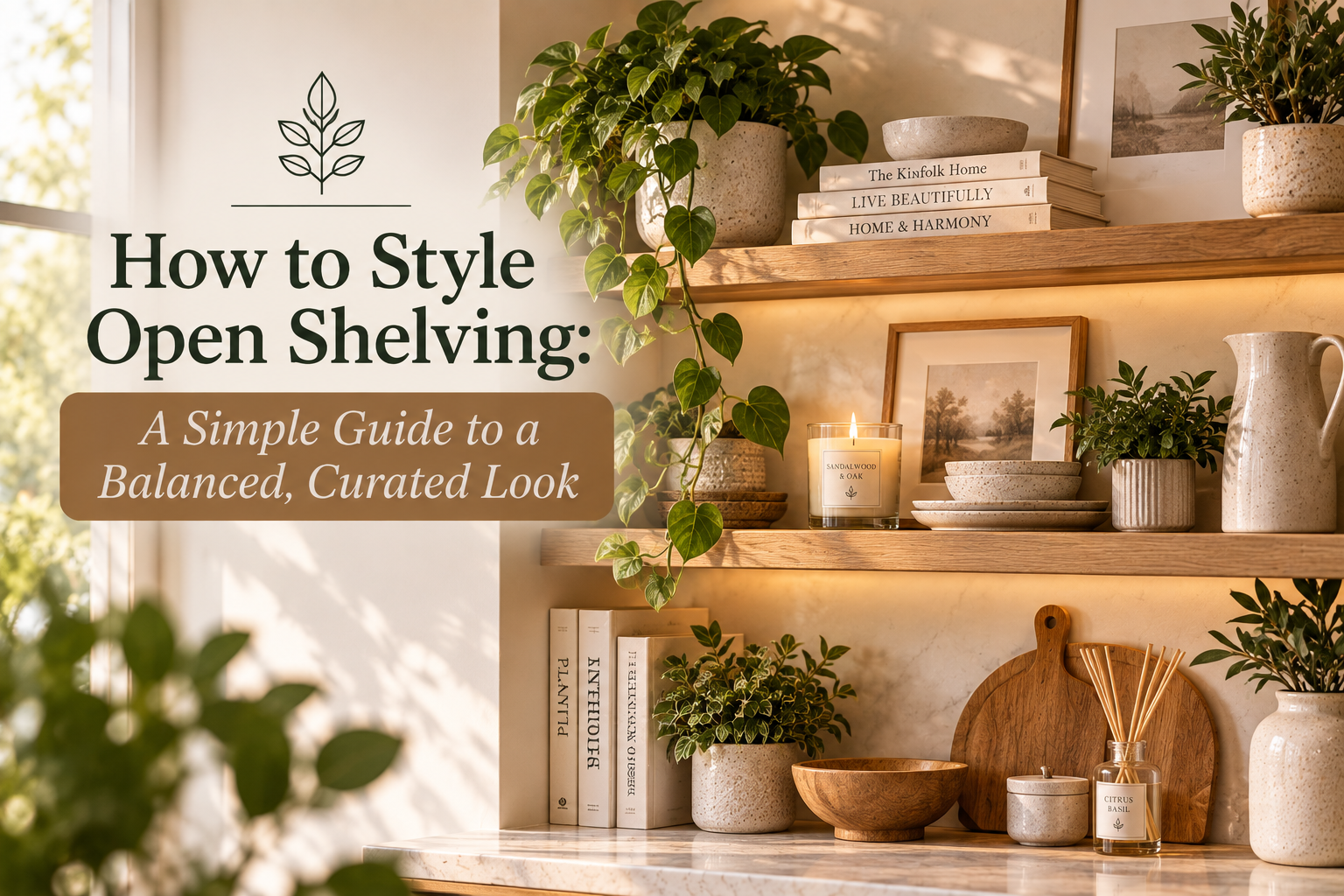
Open shelving can make a room feel more open, personal, and visually interesting. But without the right arrangement, shelves can quickly look crowded or unfinished. The trick is not to fill every empty space. Good shelf styling comes from balancing decorative objects, functional pieces, color, texture, scale, and negative space.
I’ve found that the easiest approach is to treat open shelves as one complete composition rather than styling each shelf separately. Start with a few strong pieces, build around them, and edit anything that feels unnecessary.
How to Style Open Shelving Step by Step
1. Start With a Clean, Empty Shelf
Before choosing your décor, remove everything from the shelving unit. This gives you a clear view of the available space and makes it easier to rethink the arrangement.
Take a moment to clean the shelves and decide what actually belongs there. Open shelving works best when displayed items have a purpose, whether that means adding character, providing storage, or contributing to the overall look.
Avoid putting everything back simply because it was there before. Think of the empty shelves as a blank canvas.
2. Choose a Few Large Anchor Pieces First
Start with your largest decorative objects. These become anchor pieces that establish visual weight and give the rest of the arrangement direction.
A large vase, framed artwork, woven basket, sculptural object, or substantial stack of books can work well. Place larger pieces across different areas rather than concentrating them on one side.
The goal is not perfect symmetry. Instead, distribute visual weight so one section does not feel noticeably heavier than another.
3. Mix Heights, Shapes, and Sizes
One of the simplest ways to make open shelves look professionally styled is to vary the height and scale of your objects.
Combine tall, medium, and low pieces. For example, place a tall vase beside a shorter ceramic bowl or position a small object on top of a stack of books.
Shape matters too. Rectangular books, rounded ceramics, framed artwork, and organic greenery create more visual interest than several objects with identical silhouettes.
Varying scale also prevents the shelves from looking flat or repetitive.
4. Layer Objects to Create Depth
Placing every item in one straight line can make a shelf feel rigid. Layering introduces depth and makes the arrangement feel more collected.
Try placing artwork or a picture frame toward the back, then position a smaller object or plant slightly in front. Books can also create useful platforms for smaller decorative pieces.
Keep the layers intentional. Too much overlap can make objects difficult to see and quickly turn a curated display into clutter.
5. Combine Books, Plants, and Decorative Objects
The best open shelf arrangements usually mix different types of objects instead of relying on one category.
Books add structure and can introduce both color and height. Plants or fresh greenery soften hard lines and bring an organic element into the room. Vases, ceramics, bowls, candles, and sculptures add shape and texture.
Baskets and decorative boxes can provide practical storage while keeping smaller items contained. In a kitchen, cookbooks, glassware, bowls, and attractive everyday pieces can serve both decorative and functional purposes.
Choose items that complement one another instead of trying to display everything you own.
6. Create a Cohesive Color and Material Palette
You do not need every object to match. A better approach is to repeat a few colors, finishes, or materials throughout the shelving.
For example, natural wood, neutral ceramics, greenery, and a few darker accents can create a calm and cohesive display. You can also repeat one accent color through books, artwork, pottery, or smaller accessories.
Texture adds another layer of interest. Combine smooth ceramic with woven baskets, natural wood, glass, metal, or textured fabric. These subtle differences prevent a neutral shelf from looking flat.
7. Leave Enough Negative Space
One of the most common open shelving mistakes is filling every available inch.
Empty space gives decorative objects room to stand out. It also creates visual breathing room between groups of items.
Instead of asking, “What can I add here?” ask, “Does this space need anything?” Sometimes removing one small accessory improves the entire arrangement.
Negative space is not wasted space. It is part of the composition.
8. Step Back and Edit the Arrangement
Once everything is in place, step away from the shelves and view them from across the room. This often reveals problems that are difficult to notice when standing directly in front of them.
Look for areas that feel too heavy, too empty, overly repetitive, or disconnected from the rest of the room.
Move pieces between shelves, change their orientation, or remove items that do not contribute to the arrangement. I’ve found that the final editing stage often makes a bigger difference than adding another decorative piece.
Common Mistakes When Styling Open Shelving
Avoid filling every shelf to maximum capacity. Too many small accessories can create visual noise.
Using objects with identical heights can also make a display feel monotonous. Introduce variation through scale, shape, and placement.
Another common mistake is using too many unrelated colors and materials. Repeating a few visual elements creates cohesion without making everything look identical.
Finally, avoid styling every shelf as a separate display. Look at the entire shelving unit as one composition and distribute visual weight across it.
How to Make Open Shelving Look Balanced, Not Cluttered
A simple formula can make shelf styling easier:
Start with anchor pieces, vary heights and shapes, add layers, introduce books or greenery, repeat a few colors or materials, then leave breathing room.
Balance does not mean making both sides identical. Asymmetrical arrangements can look more natural and relaxed when the visual weight feels evenly distributed.
If a shelf still feels cluttered, remove something before adding anything else.
Frequently Asked Questions About Styling Open Shelving
What should you put on open shelves?
Use a combination of books, plants, vases, artwork, ceramics, baskets, photographs, and selected functional items. Choose pieces that add height, texture, color, storage, or personality.
How do you make open shelves look less cluttered?
Remove unnecessary items, group related pieces, vary object heights, limit the color palette, and leave negative space around important objects.
How do you arrange things on open shelves?
Begin with larger anchor pieces, then add medium-sized objects, books, greenery, and smaller accents. Layer some pieces to create depth and step back to check the overall visual balance.
Should open shelves be symmetrical?
Not necessarily. Symmetry can create a structured appearance, while balanced asymmetry often feels more relaxed. Focus on distributing visual weight rather than making both sides identical.
Final Thoughts
Styling open shelving becomes much easier when you stop thinking about filling space and start thinking about composition. Use a few meaningful pieces, create variation in height and texture, mix decorative and functional objects, and give each group enough breathing room.
For finishing touches, explore home decor from Lume & Wick to find decorative accents, lighting, and pieces that can help bring your shelf arrangement together without making it feel overdone.