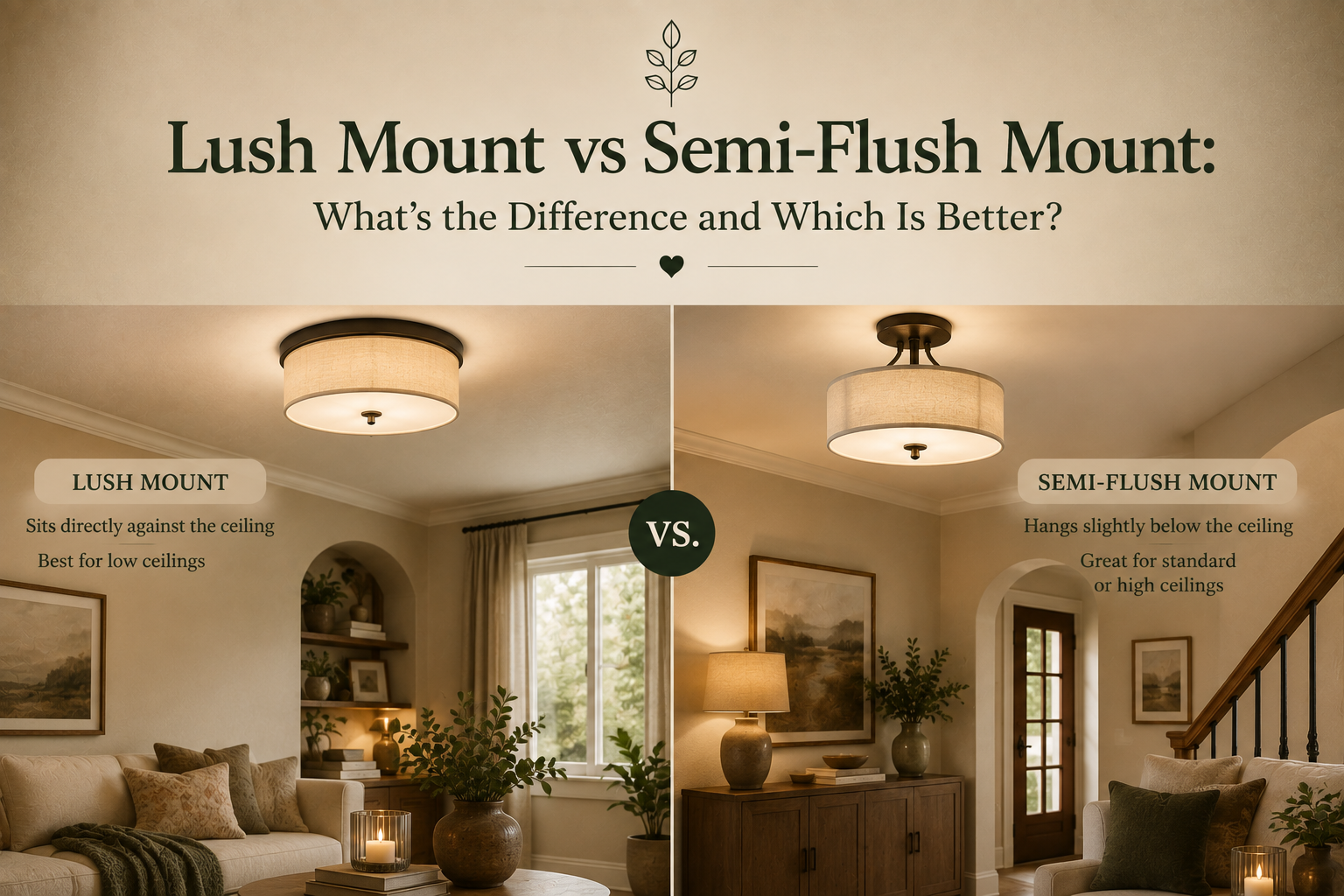
If you are comparing lush mount vs semi-flush mount lighting, the main difference comes down to how far the fixture extends from the ceiling. The standard lighting term is flush mount, which sits directly against the ceiling. A semi-flush mount hangs slightly below it. That small difference affects ceiling clearance, fixture height, appearance, and sometimes light distribution.
I have used both styles in different rooms, and the choice rarely comes down to which fixture is simply “better.” A flush mount usually makes more sense when headroom and a clean profile matter most. A semi-flush fixture can work better when you want more decorative presence without using a pendant or chandelier.
Flush Mount vs Semi-Flush Mount: What Is the Actual Difference?
Both fixtures belong to the broader category of ceiling-mounted lighting. They provide general or ambient illumination without requiring the vertical space needed by hanging fixtures. The key distinction is their mounting position.
A flush mount ceiling light attaches directly to the ceiling surface. Its compact construction keeps the fixture close to the ceiling and maximizes usable headroom.
A semi-flush ceiling light uses a short stem, rod, or mounting section to position the shade slightly below the ceiling. This creates more visual depth and can change how light spreads through the room.
| Factor | Flush Mount | Semi-Flush Mount |
|---|---|---|
| Ceiling clearance | Maximum | Moderate |
| Fixture height | Very low | Slightly taller |
| Profile | Flat and streamlined | More dimensional |
| Low-ceiling suitability | Excellent | Depends on fixture height |
| Visual presence | Subtle | More decorative |
| Vertical space required | Minimal | Greater |
| Light direction | Often downward or diffused | May provide upward and downward light |
The exact performance still depends on the individual fixture. Shade material, bulb position, diffuser design, lumens, and beam direction can all influence the final lighting effect.
Flush Mount Lighting
A flush mount light sits directly against the ceiling, making it one of the most space-efficient options for overhead illumination. Its low-profile construction works especially well in bedrooms, hallways, compact living spaces, and rooms with limited ceiling height.
I particularly like flush fixtures when the goal is to keep the ceiling visually quiet. They do not compete with furniture, artwork, or architectural details. Many modern versions also use integrated LEDs or replaceable LED bulbs, allowing them to provide broad, even illumination without adding much physical bulk.
Semi-Flush Mount Lighting
A semi-flush mount fixture sits slightly below the ceiling, giving it more depth and decorative character. That extra space can also affect the direction of illumination. Some designs allow light to travel upward toward the ceiling while the main source illuminates the room below.
This style is useful when a room needs a stronger focal point but does not have enough vertical clearance for a pendant or chandelier. In my experience, a well-proportioned semi-flush fixture can make an ordinary ceiling feel more intentional without overwhelming the room.
Flush Mount vs Semi-Flush Mount Compared on Key Factors
The best way to compare these ceiling fixtures is to look beyond appearance. Ceiling height, fixture dimensions, light distribution, room size, and the desired atmosphere all affect the final result. I have found that checking these practical factors before choosing a fixture prevents most lighting mistakes. Our lighting output calculator turns room size and use into a brightness target.
Ceiling Clearance and Fixture Height
Flush mount lighting provides the greatest ceiling clearance because the fixture sits directly against the ceiling. This makes it especially suitable for rooms where people move close to the light, such as hallways, bedrooms, closets, and compact entryways.
Semi-flush fixtures need more vertical space because the shade hangs below the mounting point. They can still work well with standard-height ceilings, but always check the fixture’s actual height rather than assuming every semi-flush model has the same clearance.
Light Distribution
Light distribution can differ considerably between individual designs. A flush fixture with an opaque diffuser may spread soft, downward illumination across a room. Another model may use exposed bulbs or a translucent shade for broader ambient lighting.
Semi-flush fixtures often provide more opportunities for layered illumination. A shade can direct light downward while an open upper section allows some light to reflect off the ceiling. That reflected light can create a softer atmosphere.
However, mounting style alone does not determine brightness. Check the lumen output, bulb type, wattage, color temperature, diffuser, and beam angle when comparing actual products.
Visual Presence and Interior Style
Flush mounts usually create a clean, understated appearance. Their compact profile works naturally with minimalist, contemporary, and practical interiors.
Semi-flush mounts have greater visual presence. Their shade, frame, finish, and proportions can become part of the room’s decor. I tend to use them when the ceiling needs a decorative feature but a hanging fixture would feel too prominent.
Room Size and Proportion
Room scale also matters. A small flush mount can disappear in a large room, while an oversized fixture can dominate a compact space.
Semi-flush lighting often gives medium-sized rooms more visual structure because its greater projection adds depth. Still, proportion matters more than the fixture category. Measure the room and compare the fixture diameter and height before installation.
Low Ceilings vs Higher Ceilings
For low ceilings, flush mount lighting usually offers the safest solution. It preserves headroom and reduces the chance of the fixture feeling intrusive.
With higher ceilings, semi-flush lighting can provide additional visual interest. It fills some of the vertical space without dropping as far into the room as a pendant or chandelier.
When Is a Flush Mount the Better Choice?
Choose a flush mount when space efficiency and ceiling clearance are your main priorities. It works particularly well in low-ceiling rooms where a projecting fixture could feel uncomfortable or visually crowded. If ceiling height is tight and you would rather skip a fixture altogether, compare can lights vs recessed lighting. Our plan your recessed lighting gives you the fixture count and spacing for your ceiling.
Flush mounts also suit homeowners who prefer discreet overhead lighting. Their close-to-ceiling construction keeps the fixture visually restrained, which works well in bedrooms, hallways, kitchens, closets, and smaller living areas.
Another advantage comes from installation flexibility. Because the fixture requires little vertical space, you have more freedom to place it in circulation areas where a hanging light could become an obstruction.
When Is a Semi-Flush Mount the Better Choice?
A semi-flush mount makes sense when you want more decorative impact without committing to a pendant or chandelier. Its short drop adds dimension while keeping the fixture relatively close to the ceiling.
This option can work particularly well in living rooms, dining areas, bedrooms, entryways, and other spaces with enough vertical clearance. Models with an open top can also contribute to upward illumination, which may soften the overall appearance of the room.
The important point is to check the actual fixture height. A semi-flush design with a long projection may not suit a low ceiling, even if its category suggests close-to-ceiling installation.
Which Should You Choose: Flush Mount or Semi-Flush Mount?
There is no universal winner between these two ceiling light styles. The right choice depends on the room and the result you want from the fixture. Not sure about scale? Our what size chandelier you need suggests diameter and drop for your room or table.
Choose a flush mount if:
- Your ceiling is low.
- You want maximum headroom.
- You prefer a clean, minimal profile.
- The light needs to work in a hallway, bedroom, closet, or compact room.
- You want the fixture to blend into the ceiling rather than become a focal point.
Choose a semi-flush mount if:
- Your ceiling provides enough vertical clearance.
- You want a more decorative ceiling fixture.
- You like a fixture with greater visual depth.
- You want the possibility of both upward and downward illumination.
- A pendant or chandelier would feel too large or hang too low.
Before buying, I recommend measuring the ceiling height and checking the fixture’s total height and diameter. Then consider the room’s size, furniture placement, desired brightness, and lighting color. A fixture that looks perfect in a showroom can feel oversized or undersized once installed in an actual room.
Final Verdict
The difference between flush mount and semi-flush mount lighting is simple, but its effect on a room can be significant. Flush mount fixtures sit directly against the ceiling, maximize clearance, and provide a streamlined solution for spaces with limited vertical room. Semi-flush fixtures extend slightly downward, creating more decorative presence and, in some designs, more varied light distribution.
After trying both styles, I would not choose based on appearance alone. Start with ceiling height and fixture dimensions, then consider illumination and interior style. If you need a discreet, space-saving fixture, flush mount is usually the practical choice. If you have more room and want the ceiling light to contribute to the decor, semi-flush can be the better fit.
Once you know which style suits your space, explore home lighting from Lume & Wick to find a fixture that balances function, proportion, and the character you want your room to have. Whichever style you choose, cleaning a glass light fixture regularly keeps the light output clear.