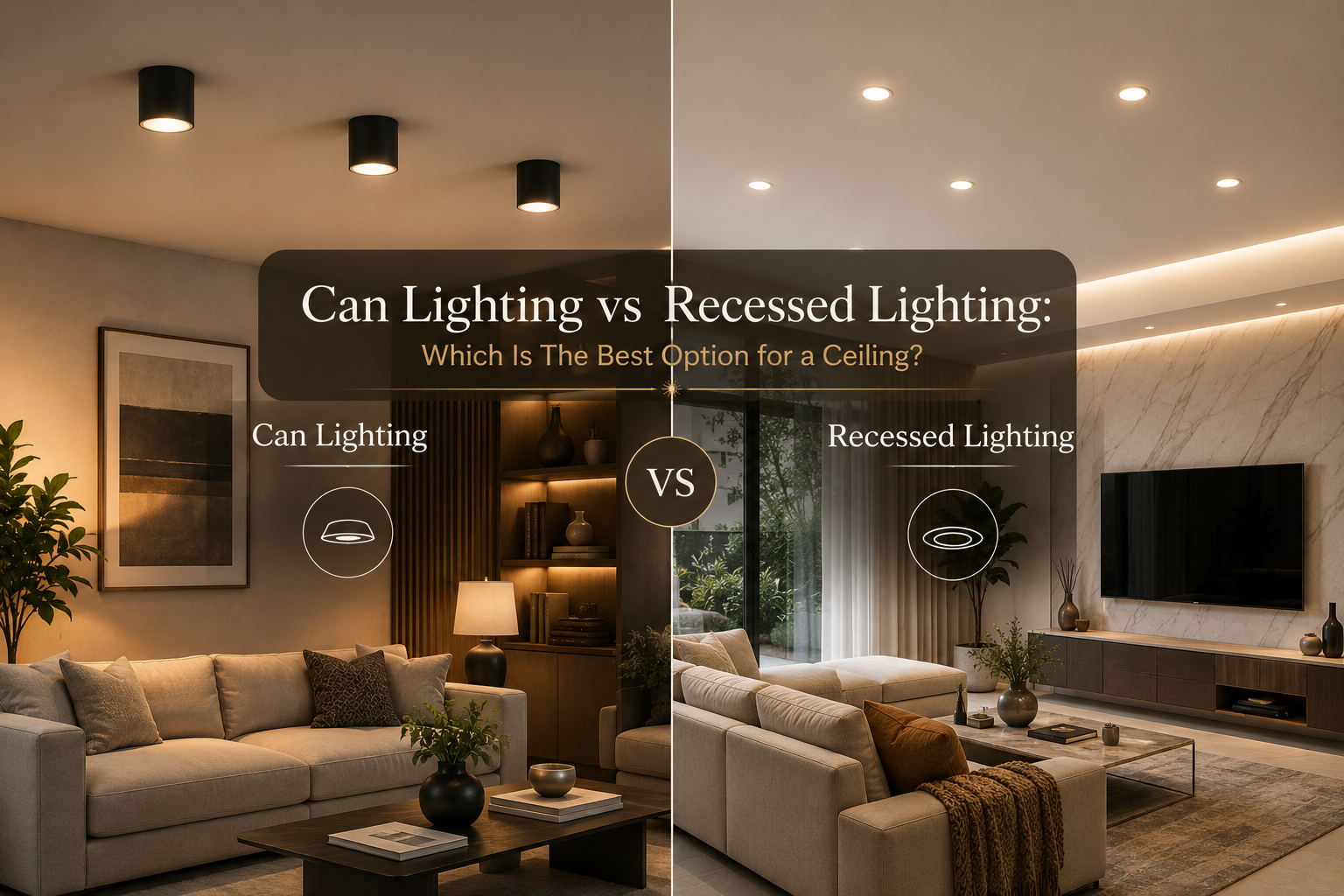
I get this question constantly from homeowners planning a renovation: are can lights and recessed lights the same thing, or different products entirely? After years of specifying and installing both in kitchens, hallways, and living rooms, I can tell you the confusion makes sense.
The terms overlap so often in everyday speech that most people treat them as identical. Technically, they aren’t quite the same, and knowing the distinction will save you money and headaches before you drill a single hole in your ceiling.
This guide breaks down what each term really means, where they diverge, and how to pick the right one for your space.
What Is Recessed Lighting?
Recessed lighting is the broad category. Think of it as the umbrella term for any fixture that sits flush inside the ceiling instead of hanging or mounting on its surface. Unlike pendant lights or flush-mount fixtures, recessed lighting disappears into the ceiling plane, leaving only the trim visible from below.
Every recessed fixture shares three basic parts: the housing that sits inside the ceiling cavity, the trim that frames the opening, and the light source itself, whether that’s a traditional bulb or an integrated LED module. Downlights, wafer lights, and yes, can lights, all fall under this category. The ceiling cutout size determines what trim and housing combination will fit, which matters a lot once you start shopping.
What Is a Can Light?
A can light is a specific, older style of recessed lighting. The name comes from the metal cylindrical housing, shaped literally like a can, that holds a traditional bulb above the ceiling line. I’ve pulled apart enough of these in older homes to recognize the setup instantly: deep housing, a separate junction box for wiring, and a bulb you can physically swap out. Our recessed lighting calculator gives you the fixture count and spacing for your ceiling.
Originally built for incandescent and halogen bulbs, can lights need more vertical depth than newer LED alternatives.
They’re still common in houses built before LED retrofit kits became standard, and in many cases, that original can housing is still usable today with the right upgrade. In short, every can light is a recessed light, but not every recessed light is a can light.
Can Lights vs Recessed Lighting: Key Differences
1. Housing and Depth Requirements
This is where the real difference shows up. Traditional can housings demand serious ceiling clearance, often six inches or more, to accommodate the bulb and heat dissipation space above it. Newer recessed fixtures, especially wafer lights and slim recessed units, solve this problem entirely.
I’ve installed wafer lights in ceilings with barely two inches of clearance, something a standard can housing could never manage. If your attic space is tight or you’re working under a concrete slab, housing depth becomes the deciding factor before style even enters the conversation.
2. Heat Output and Energy Efficiency
Incandescent can lights run hot. That heat isn’t just a safety concern near insulation, it also wastes energy that could otherwise go toward actual brightness. LED recessed fixtures produce a fraction of the heat while delivering more lumens per watt. Our total lumens calculator works out total lumens from room size and use.
Switching a home full of old can lights to LED alternatives is one of the fastest, most noticeable upgrades I’ve recommended to clients wanting lower electric bills without sacrificing brightness.
3. IC-Rated vs Non-IC Rated Housing
If insulation touches or surrounds your ceiling fixtures, the housing must carry an IC rating, meaning it’s designed to safely contact insulation without overheating. Non-IC rated housings need clearance from insulation, which isn’t always practical in modern attics.
Older can-style housings are frequently non-IC rated, so this is worth checking before assuming your existing setup meets code.
4. Retrofit vs New Construction Use
New construction housing gets installed before drywall goes up, giving contractors full access to wiring and framing. Remodel housing, by contrast, is built for existing ceilings, sliding in through a cutout without disturbing surrounding structure.
If you already have can lights, retrofit LED kits let you upgrade the bulb and trim without replacing the entire housing, saving both labor and demolition mess.
Which One Should You Choose?
Your decision comes down to what you’re starting with and what your ceiling allows. Renovating a space with existing can housings? Retrofit LED kits are usually the fastest, least invasive route since they reuse the junction box and housing already in place. For the whole-room picture, see how to choose lighting for your home. Not sure how much light you need? Try our lighting calculator for any room.
Building new or gutting down to the studs? That’s your chance to install slim, low-clearance housing designed for LED from the start, giving you more flexibility with cutout size and placement.
Beyond housing type, a few details shape everyday satisfaction with the fixture. Dimmable LED recessed lights pair well with living rooms and bedrooms where mood matters. Color temperature deserves real thought too: warmer Kelvin ranges around 2700K suit cozy spaces, while cooler tones near 4000K to 5000K work better in kitchens and bathrooms where task lighting matters.
Trim style also affects both function and look, baffle trim softens glare, while gimbal and adjustable trims let you angle light toward artwork or a specific wall.
Common Mistakes to Avoid
The most frequent error I see is mismatching trim size to housing, resulting in gaps or fixtures that won’t seat properly. A close second is ignoring IC ratings in insulated ceilings, which creates a genuine fire hazard over time.
Bathrooms and outdoor spaces bring their own pitfall: installing fixtures without a proper damp or wet rating leads to moisture damage and premature failure. Each mistake is avoidable with a five-minute check before purchase.
Conclusion
At the end of the day, can lights are simply one type of recessed lighting, not a separate product altogether. Choosing between them comes down to your ceiling depth, insulation situation, and whether you’re renovating or building fresh.
If you want more tested guides like this one before your next lighting project, Lume & Wick’s home lighting collection is a great place to start browsing.