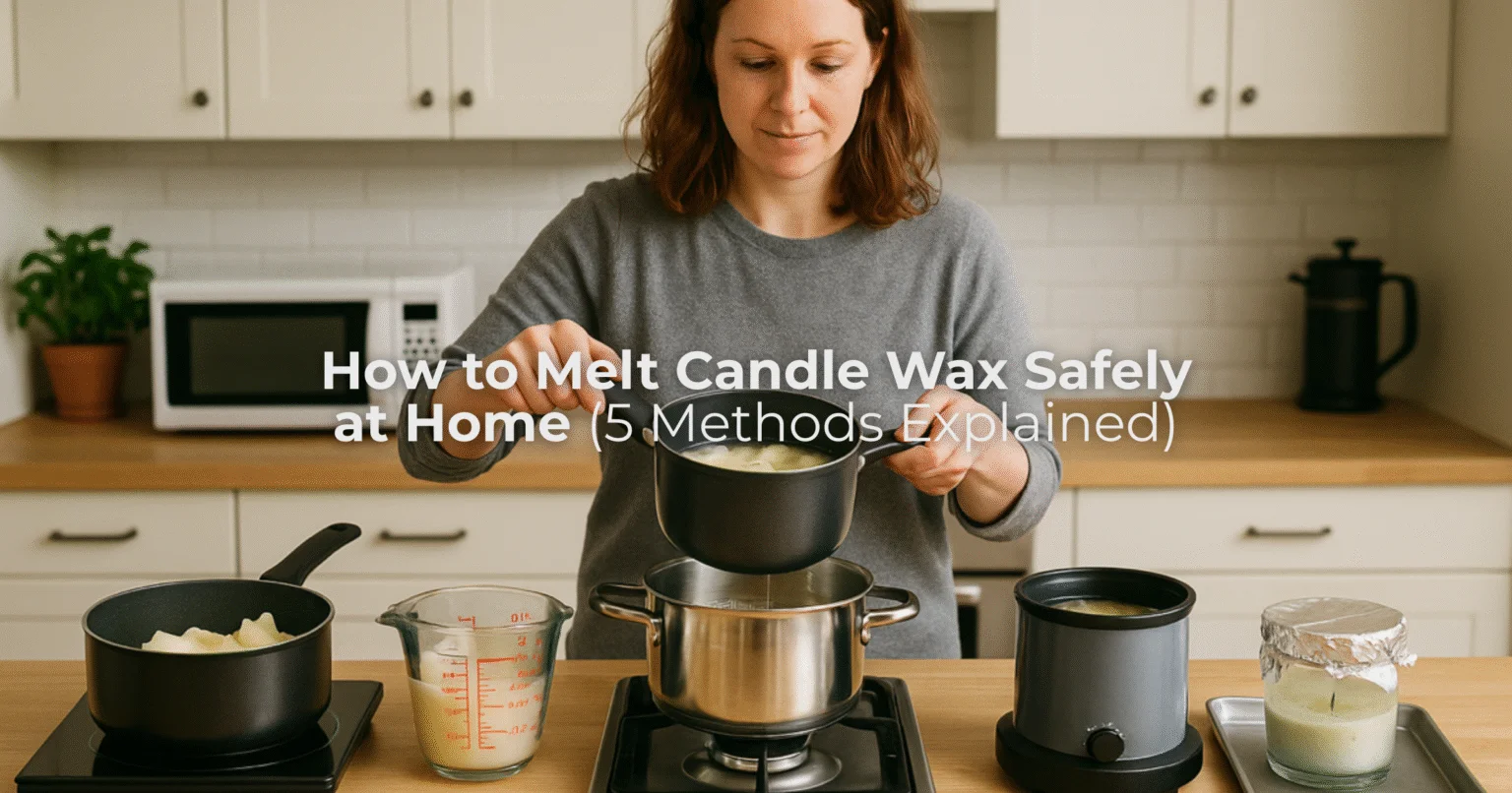
I started melting leftover candle wax years ago, after I noticed how much wax sits unused at the bottom of every jar when making candles. Not sure how much to melt? Our free candle wax calculator sizes it to your container or mould.
The method matters more than most people expect. Get the temperature wrong, and you lose fragrance, get cloudy tops, or scorch the wax. Get it right and leftover wax pours as cleanly as new.
I have tested five methods at home: the stove, the microwave, a double boiler, a dedicated wax melter, and a low oven. Below is what each one is actually good for, the temperatures I use, and the safety rules I do not break.
Safety Rules for Melting Wax
Wax is a fuel. Treat it like hot oil, not hot water.
Never put wax over direct heat. Always use water or a thermostat between the flame and the wax.
Know the flash point. Paraffin ignites near 390°F (199°C). Soy ignites near 490°F (254°C). An empty pan on a hot burner reaches both in minutes.
Never throw water on a wax fire. Water sinks under the wax, flashes to steam, and sprays burning wax across the room. Smother the pan with a lid or use a Class B extinguisher.
Remove metal wick tabs before microwaving. Old candle jars almost always hide a metal disc at the base. It will arc.
Keep a thermometer in the wax, not in the water. The water tells you nothing useful.
Never leave melting wax unattended. Not for the stove, not for the microwave, not for the oven.
What Temperature Does Candle Wax Melt At?
Melt point and pour point are two different numbers. Most people confuse them, then wonder why the tops set rough.
| Wax | Melt point | Add fragrance at | Pour at |
|---|---|---|---|
| Soy (container) | 120-125°F / 49-52°C | 180-185°F / 82-85°C | 130-140°F / 54-60°C |
| Paraffin | 115-155°F / 46-68°C | 180-185°F / 82-85°C | 150-160°F / 66-71°C |
| Beeswax | 144-147°F / 62-64°C | 160-165°F / 71-74°C | 155-160°F / 68-71°C |
| Coconut blend | 100-110°F / 38-43°C | 175-180°F / 79-82°C | 125-135°F / 52-57°C |
| Paraffin-soy blend | 125-135°F / 52-57°C | 180-185°F / 82-85°C | 140-150°F / 60-66°C |
Paraffin has the widest range because grade changes everything. Check the spec sheet from your supplier if you have it.
Which Method Should You Use?
| Method | Best for | Time | Fragrance retention |
|---|---|---|---|
| Double boiler | New candles, any batch size | 20-30 min | Excellent |
| Stove | Medium batches, no special kit | 15-25 min | Excellent |
| Wax melter | Repeat production runs | 30-45 min | Good |
| Microwave | Under 4 oz, reuse only | 2-3 min | Fair |
| Low oven | Emptying old jars | 20 min | Poor |
How to Melt Candle Wax at Home?
Want to reuse leftover candles or start making your own? Learn how to melt candle wax safely at home using five easy and reliable methods.
From the stove and microwave to the double boiler, wax melter, and aluminum foil technique, these steps help you achieve smooth, even melting while preserving fragrance and color.
1. Melt Candle Wax on the Stove
The stove is my default when I do not want to unpack the melter. It handles soy, paraffin, and beeswax equally well.
Fill a saucepan with two inches of water. Set a heat-resistant pouring jug or a clean metal tin inside it. The jug should sit on the base without wobbling, but the water should not reach high enough to lift it.
Cut the wax into pieces no larger than a sugar cube. Big chunks melt from the outside in, which means the outer wax overheats while the core is still solid.
Bring the water to a bare simmer, not a rolling boil. A rolling boil splashes water into the wax and pushes the jug around. Hold it at a simmer and let the wax come up slowly.
Stir every few minutes with a metal or silicone stirrer. Clip a thermometer into the wax itself. Soy turns fully clear near 130°F. Beeswax needs closer to 150°F. Once every solid piece is gone and the liquid runs clear, take the jug off the heat.
This method gives you the most control for the least equipment. It is also the easiest to walk away from, so do not.
2. Melt Candle Wax in the Microwave
The microwave is fast and unforgiving. I only use it for small reuse jobs, never for a candle I intend to sell or gift.
Check for metal first. Old jar candles hide a metal wick tab under the wax, and votives often have one too. Pry it out before the wax goes anywhere near the microwave.
Cut the wax into even chunks and load a microwave-safe glass or ceramic container. Heat at medium power for 30 seconds. Stir. Heat again for 30 seconds. Keep going in short bursts until roughly 80 percent has liquefied, then stop and stir the rest through. Residual heat finishes the job.
The failure mode here is a hot spot. The wax near the container wall races ahead of the rest, and by the time the centre melts the edge has cooked off its fragrance. Stirring between every burst is not optional.
Keep the wax under 185°F. Above that, soy and coconut start smoking and the scent goes flat.
3. Melt Candle Wax Using a Double Boiler
A proper double boiler is the version of the stove method with the guesswork removed. The two pans nest, the water level stays consistent, and nothing slides.
Fill the lower pan and hold it at a simmer. Add the wax to the upper pan in small pieces. Stir slowly and steadily. The wax will move from cloudy to translucent to fully clear.
Once it is clear, keep heating to 180-185°F. That is the fragrance window. Take the pan off the heat, add your fragrance oil, and stir for two full minutes. Two minutes feels long. It is what actually binds the oil into the wax instead of leaving it to pool and bleed later.
Add dye at the same stage and stir it through before the wax starts to cool.
Then let the wax drop to its pour temperature before it goes into a jar. Soy pours at 130-140°F. Pour hotter than that and you get sinkholes and cracked tops.
One safety note on fragrance oils. Every oil has its own flash point, usually between 150°F and 200°F, and it is printed on the bottle. If your oil flashes below 185°F, add it at 10 degrees under its flash point instead.
4. Melt Candle Wax Using Wax Melter
A melter earns its place once you are pouring more than a few candles a month. The thermostat holds temperature without you standing over it, and the spout pours cleanly.
I set mine to 185°F to melt and add fragrance, then switch it off and let the wax fall to pour temperature in the melter itself.
Do not park wax at 185°F for hours. A thermostat makes it easy to forget, and long holds at high heat cook fragrance out of the wax and discolour soy. Melt, scent, pour, done.
5. Melt Candle Wax Using Aluminum Foil
This is the method I use for salvage, not for making. When a jar has half an inch of wax welded to the bottom, the oven gets it out with no scraping.
Line a baking tray with foil. The foil catches the drips, which is the only job it has. Set the jars upside down on the tray if you want the wax to release, or right side up if you want to pour it off.
Set the oven to its lowest setting. Most North American ovens bottom out at 170°F or 200°F, and either works. Give it 15 to 25 minutes. Paraffin releases faster than soy.
Wear oven gloves and move the tray with both hands. Hot glass and liquid wax make a bad combination on a wobble.
Two things to know. Wick tabs come loose in the process, so fish them out. And this method strips most of the remaining fragrance, so treat the recovered wax as unscented base for wax melts or firelighters, not as scented wax you can pour again.
Final Thoughts
Melting candle wax isn’t just a task; it’s an essential skill in the candle-making process. From controlling temperature to choosing the right tools, every detail affects the result.
Whether you’re using a double boiler, microwave, or wax melter, focus on melting wax safely to preserve its quality and fragrance.
Experiment with fragrance oil mixing, wax dye blending, and cooling techniques to create candles with smooth finishes and excellent scent throw.
Once you learn to melt and reuse wax effectively, even small leftovers can turn into something beautiful.
If you prefer enjoying artisanal candles without the DIY work, explore the handcrafted collection at Lume & Wick.
FAQs on Wax Melting
Can you melt candle wax in boiling water?
Only with indirect heat, and a simmer works better than a boil. Set your wax container inside the pan so the water heats the container, never the wax directly. Water that gets into the wax will spit when you pour and cause pitting as it sets.
Will hot water melt candle wax on its own?
Boiling water at 212°F is hot enough to melt every common candle wax. Pouring it straight into a jar will loosen the wax so it floats free. It will not give you usable wax though, because water and wax separate messily. Use it to clean a jar, not to recover wax.
How do you melt leftover wax out of a candle jar?
The low oven method is cleanest. For a single jar, hot tap water in the sink and 20 minutes of patience will lift most of it.
Can I melt candle wax in the microwave?
Yes, in 30 second bursts at medium power, stirring between each one. Remove any metal wick tab first. Keep it under 4 oz and under 185°F.
Can I melt candle wax in a pot directly?
No. Direct heat drives wax past its flash point faster than you can react. Paraffin ignites near 390°F, and an empty burner reaches that quickly.
How do you melt candle wax without a double boiler?
Improvise one. A saucepan with two inches of water and a heat-resistant jug inside it does the same job.
What temperature does candle wax melt at?
Soy melts at 120-125°F, beeswax at 144-147°F, and paraffin between 115°F and 155°F depending on grade. See the table above for pour temperatures.
Is melting candle wax a chemical or physical change?
It is a physical change. The wax changes state from solid to liquid, but the molecules stay the same, which is why it hardens back into the same wax. Burning a candle is a chemical change, because combustion turns the wax into carbon dioxide and water.
What should you melt candle wax in?
A metal pouring pitcher with a spout is the standard. A heat-resistant glass jug works. Avoid anything you plan to cook with afterwards, because wax residue never fully leaves.