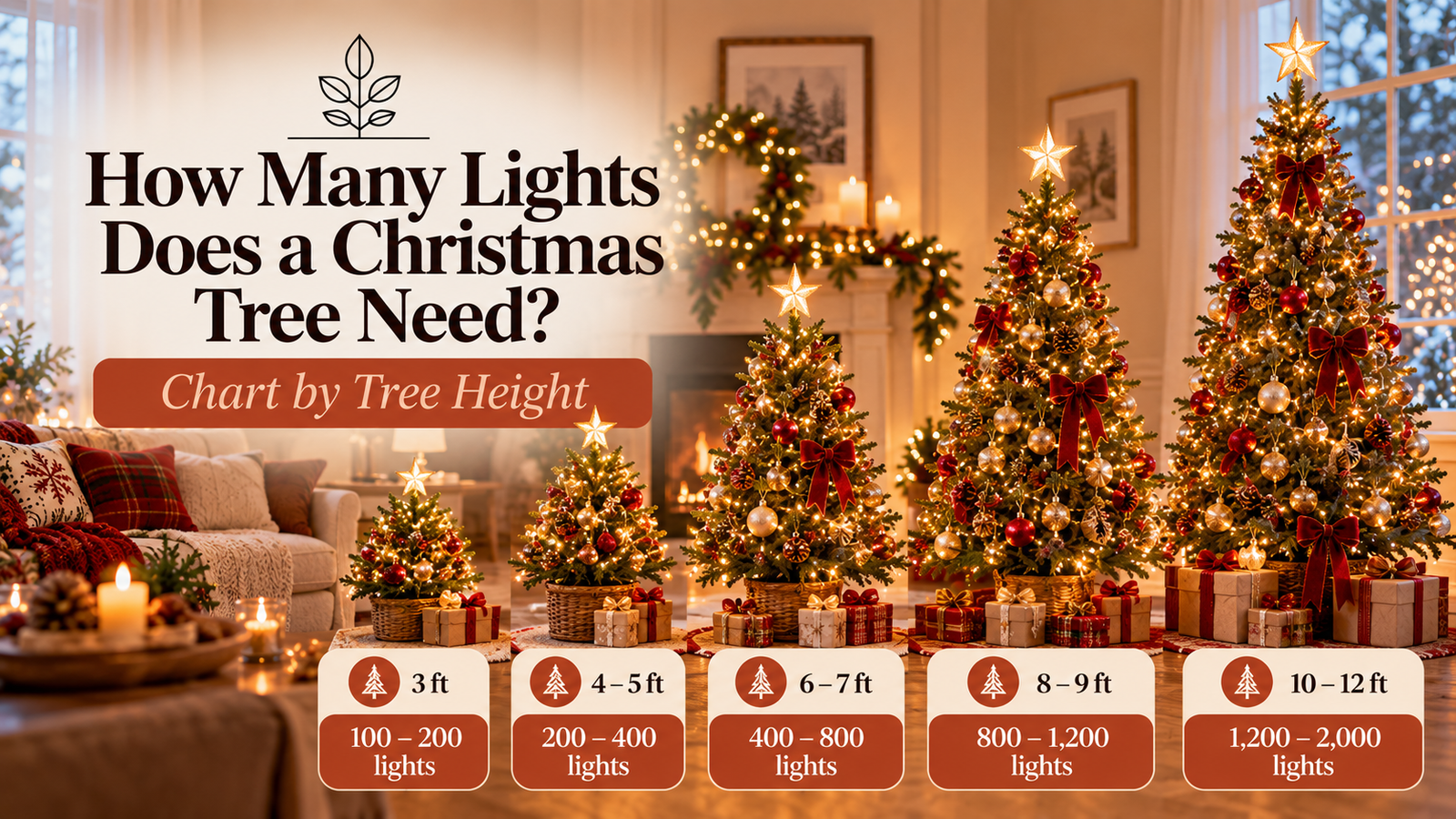
Choosing the right number of Christmas tree lights helps create a warm, balanced holiday display without leaving dark patches or overcrowding the branches. The number you need depends on tree height, width, foliage density, bulb type, and your preferred brightness.
A useful starting point is 100 mini lights per foot of tree height for a classic look. You can use fewer for a subtle glow or more for a brighter, fuller appearance. The chart below helps you estimate how many Christmas lights to buy before decorating.
How Many Lights Does a Christmas Tree Need by Height?
Use this Christmas tree light count chart to estimate the number of individual bulbs needed for different tree sizes.
\n| Tree height | Soft glow | Standard lighting | Bright lighting |
|---|---|---|---|
| 4 feet | 200 | 400 | 600 |
| 5 feet | 250 | 500 | 750 |
| 6 feet | 300 | 600 | 900 |
| 7 feet | 350 | 700 | 1,050 |
| 7.5 feet | 375 | 750 | 1,125 |
| 8 feet | 400 | 800 | 1,200 |
| 9 feet | 450 | 900 | 1,350 |
| 10 feet | 500 | 1,000 | 1,500 |
| 12 feet | 600 | 1,200 | 1,800 |
These figures are estimates based on 50, 100, or 150 lights per foot. A standard-width tree usually works well with the middle range, while a wide or densely branched tree may need additional bulbs. Slim trees often look balanced with fewer lights.
How to Calculate the Number of Christmas Tree Lights You Need
You can calculate your Christmas tree light requirements using a simple formula:
Total lights = Tree height in feet × Lights per foot
For example, a 6-foot Christmas tree needs approximately 600 lights when you use the standard guideline of 100 lights per foot. An 8-foot tree would need around 800 lights at the same density.
If you prefer a brighter display, increase the estimate to 150 lights per foot. For a softer effect, start with 50 lights per foot and add more if needed.
Think of these numbers as a planning guide rather than a strict rule. The tree’s shape and the way you distribute bulbs will influence the final result.
What Affects How Many Lights a Christmas Tree Needs?
Tree height provides a useful starting point, but several other factors influence the number of bulbs required for even coverage.
Tree Width and Branch Density
A wide, full Christmas tree has more branches to illuminate than a narrow pencil tree of the same height. Dense artificial foliage can also hide bulbs deep inside the branches, while a sparse tree allows more light to shine through.
If your tree has a broad base or thick foliage, consider buying an extra strand. A slim tree may need fewer bulbs to achieve a similar visual effect.
Desired Brightness and Lighting Style
Your preferred decorating style also matters. A soft, understated glow suits minimalist interiors, while a bright display creates a more dramatic focal point in a living room. If you are still choosing a look, our guide to Christmas decor trends for 2026 shows which colors and moods are popular this season.
For a traditional appearance, distribute lights evenly across the outer branches and place some deeper inside the foliage. For a more luminous effect, increase the bulb count and layer the lights throughout the tree.
Bulb Type and Spacing
LED mini lights provide a versatile option for indoor Christmas trees because they generally consume less electricity than comparable incandescent strings. To estimate the load on your outlet, use our light bulb wattage calculator. Larger bulbs, such as C7 or C9 lights, create a more prominent appearance and may need a different spacing approach.
Color temperature changes the mood too. Warm white lights feel cozy and traditional, while cooler whites look crisper. Our comparison of warm white vs daylight bulbs explains the difference in more detail.
Check the bulb spacing and illuminated length before buying. Two strands with the same number of bulbs can cover different amounts of tree surface if their spacing differs.
How Many Strands of Christmas Lights Do You Need?
Once you know the total bulb count, calculate how many strands to purchase.
Number of strands = Total lights needed ÷ Lights per strand
For example, a tree requiring 600 lights needs six strands containing 100 bulbs each. If each strand contains 300 bulbs, you need two strands.
Check the packaging for the number of bulbs, illuminated length, and manufacturer-approved connection limits. Do not assume every strand can connect directly to another. Follow electrical safety instructions, and use indoor-rated lights for indoor trees. For a tidy finish near the outlet, see these tips on how to hide lamp cords.
How to Put Lights on a Christmas Tree Evenly
Good placement can make a Christmas tree look brighter and more balanced without adding unnecessary bulbs.
- Test the lights first. Check every strand before placing it on the tree.
- Start near the trunk. Work from the inner branches toward the outer tips to create depth.
- Move from bottom to top. Distribute lights around the tree rather than concentrating them on the front.
- Check for dark patches. Step back occasionally to identify gaps and redistribute bulbs.
- Finish with a final check. Make sure the lights look balanced from different viewing angles and that all electrical connections remain safe.
A little attention to light distribution makes a noticeable difference. Even coverage often looks better than placing too many bulbs on the outer branches.
Frequently Asked Questions
How Many Lights Does a 6-Foot Christmas Tree Need?
A 6-foot tree typically needs around 600 mini lights for standard lighting. Choose approximately 300 for a softer glow or 900 for a brighter appearance. Tree width and foliage density can change these estimates.
Are 500 Lights Enough for a 7-Foot Christmas Tree?
Yes, 500 lights can work for a subtle display, especially on a slim tree. However, a wide or full 7-foot tree may need closer to 700 lights or more for balanced coverage.
Is It Better to Use More Small Lights or Fewer Large Bulbs?
Mini lights create a fine, evenly distributed glow, while larger bulbs produce a more noticeable decorative effect. Neither option is universally better. Choose based on your tree’s size, preferred style, bulb brightness, and spacing.
Final Thoughts
The right number of Christmas tree lights depends on more than height alone. Use the chart as a starting point, consider the tree’s fullness, and adjust the bulb count to suit your preferred atmosphere. Even placement can help create a welcoming holiday display without unnecessary excess.
Once your lighting plan is ready, explore Lume & Wick’s Home Decor collection for complementary decorative accents that help bring warmth and seasonal character to your home.